01. What Is the Repo Rate?
The repo rate is the interest rate at which the Reserve Bank of India lends short-term money to commercial banks against eligible securities.
It is one of the RBI's most important monetary-policy tools. When the RBI changes the repo rate, the decision can eventually influence borrowing costs, consumer spending, business investment, inflation and financial-market conditions.
The simple rule
Repo Rate ↑ → Borrowing Costs ↑ → Demand Slows → Inflationary Pressure Can Reduce
The impact is not immediate or identical across the economy. Banks may adjust lending and deposit rates at different speeds, and the final effect depends on liquidity, credit demand, inflation and broader economic conditions.
02. What Happens After a Repo-Rate Increase?
A repo-rate increase affects different parts of the economy differently. Borrowers usually face higher costs, while savers and new fixed-income investors may benefit from higher rates.
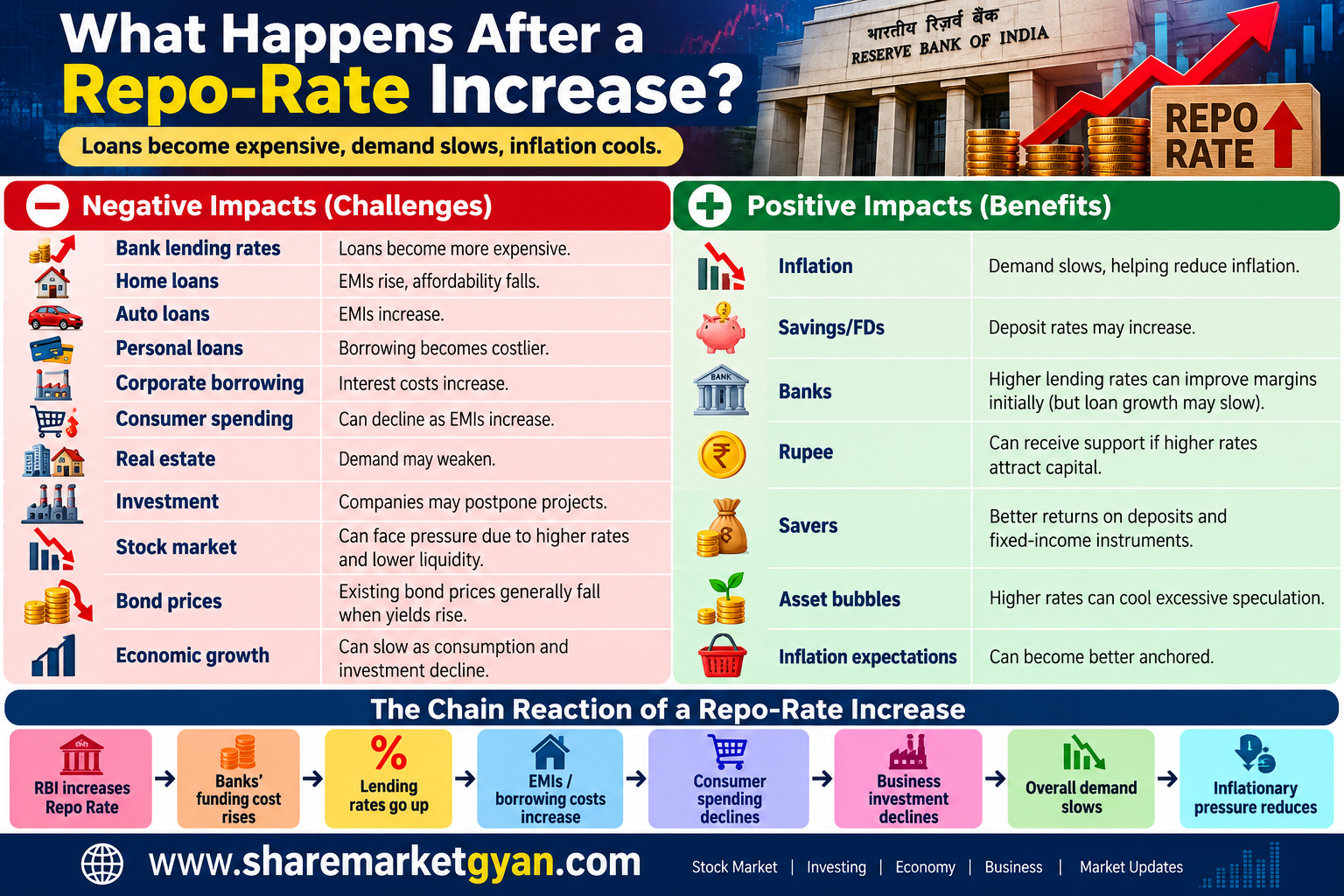
| Area | Likely Impact | Impact |
|---|---|---|
| Bank lending rates | Loans become more expensive | Negative |
| Home loans | EMIs may rise or affordability may fall | Negative |
| Auto loans | Vehicle financing becomes more expensive | Negative |
| Personal loans | Borrowing costs increase | Negative |
| Corporate borrowing | Interest expenses can increase | Negative |
| Inflation | Lower demand can reduce inflationary pressure | Positive |
| Savings / FDs | Deposit rates may increase | Positive |
| Banks | Margins can improve initially, but credit growth may slow | Mixed |
| Stock market | Higher rates can pressure valuations and liquidity | Usually Negative |
| Real estate | Higher financing costs can weaken demand | Negative |
| Bond prices | Existing bond prices generally fall when yields rise | Negative |
| Economic growth | Consumption and investment can slow | Negative |
03. Impact on Loans and EMIs
One of the most visible effects of a repo-rate increase is higher borrowing costs.
When banks face higher funding costs, they may increase lending rates. Borrowers with floating-rate loans are generally more exposed to such changes than borrowers with fixed rates.
Home Loans
A higher home-loan interest rate can increase the EMI or extend the effective repayment period. This can reduce the amount a household is willing or able to borrow.
Auto Loans
Higher financing costs can make cars and two-wheelers less affordable, particularly for price-sensitive consumers.
Personal Loans
Personal loans generally carry higher interest rates than many secured loans. A rise in borrowing costs can therefore have a noticeable impact on monthly repayment obligations.
Important
The exact EMI impact depends on the loan amount, outstanding principal, interest-rate reset mechanism and remaining tenure. A repo-rate increase does not mean every borrower's EMI changes by the same amount.
04. Why Does RBI Increase the Repo Rate?
One of the main reasons for monetary tightening is to control inflationary pressure and prevent inflation expectations from becoming entrenched.
Repo rate increases
Banks' short-term funding becomes more expensive.
Lending rates rise
Borrowing costs for households and businesses can increase.
Borrowing and spending slow
Consumers may postpone purchases and companies may delay investment.
Demand cools
Lower demand can reduce pressure on prices.
Inflationary pressure reduces
Monetary policy works toward bringing inflation under control.
However, interest rates cannot directly solve every type of inflation. Supply shortages caused by weather, commodity disruptions or geopolitical events may not respond quickly to higher interest rates.
05. Impact on Savers and Fixed Deposits
A repo-rate increase is not negative for everyone. People who depend on interest income can potentially benefit when banks increase deposit rates.
- Fixed deposits: New deposits may receive better interest rates.
- Savings: Banks may gradually reprice certain deposit products.
- Conservative investors: Higher fixed-income yields can improve income opportunities.
- New investors: Future fixed-income investments can be made at higher prevailing yields.
The important distinction is between existing and new investments. A higher-rate environment generally benefits investors making new fixed-income investments more than investors already locked into older lower-rate products.
06. Impact on Businesses and Corporate Profits
Companies that rely heavily on borrowing can face higher interest expenses when financing costs rise.
Higher Interest Cost
Interest Expense ↑ → Profit Before Tax ↓ → Net Profit Can ↓
The effect is particularly important for highly leveraged companies and businesses that require large amounts of capital for expansion.
Sectors That Can Be More Rate-Sensitive
- Real estate
- Construction
- Infrastructure
- Capital goods
- Automobiles
- Highly leveraged businesses
- Businesses dependent on consumer financing
Companies with strong cash balances and low debt may be relatively better positioned because they have less dependence on external borrowing.
07. Impact on Banks
The effect of higher interest rates on banks is more complicated than simply calling it positive or negative.
Potential Positive Impact
If banks increase lending rates faster than their deposit costs, their net interest margin can improve.
Potential Negative Impact
Higher rates can reduce loan demand. If borrowers face repayment stress, banks may also experience deterioration in asset quality and higher credit costs.
| Banking Factor | Possible Impact |
|---|---|
| Lending rates | Increase |
| Net interest margin | Can improve initially |
| Loan demand | May slow |
| Credit growth | May moderate |
| Borrower stress | Can increase |
| Credit costs | Can increase if asset quality weakens |
08. Impact on the Stock Market
A repo-rate increase is generally considered a negative factor for equities because higher interest rates can reduce liquidity, increase financing costs and lower the valuation investors are willing to pay for future earnings.
However, the impact is not uniform across all stocks.
Stocks and Sectors That May Face Pressure
- Highly leveraged companies
- Real estate stocks
- Auto companies
- Consumer discretionary businesses
- Capital-intensive companies
- High-valuation growth stocks
Companies That May Be Relatively Better Positioned
- Low-debt companies
- Cash-rich companies
- Businesses with strong pricing power
- Companies with stable recurring cash flows
Important Market Rule
The stock market reacts not only to the rate decision but also to whether the decision was expected or unexpected.
09. Impact on Bonds and Bond Prices
Bond prices and market yields generally move in opposite directions.
Remember This Relationship
Interest Rates ↑ → Bond Yields ↑ → Existing Bond Prices ↓
Existing bonds paying lower coupons become less attractive when newly issued bonds offer higher yields. Their market prices can therefore decline.
For new bond investors, however, higher market yields can create an opportunity to invest at better rates.
10. Impact on Real Estate
Real estate is particularly sensitive to borrowing costs because property purchases often involve large amounts of debt.
Higher mortgage rates can reduce affordability and cause some buyers to postpone purchases.
Developers can also face higher financing costs, particularly when projects depend heavily on borrowed capital.
However, the effect can differ between affordable, mid-income and luxury housing because buyer dependence on financing varies significantly across these segments.
11. Impact on the Indian Rupee
A higher domestic interest-rate environment can sometimes support the rupee by making Indian interest-bearing assets more attractive to investors.
But this relationship is not guaranteed.
The rupee is also influenced by the US dollar, US interest rates, crude oil prices, foreign portfolio flows, India's trade balance, global risk appetite and geopolitical developments.
Do Not Use This as a Standalone Rule
Repo Rate ↑ does not automatically mean Rupee ↑. Currency markets depend on many variables simultaneously.
12. Impact on Economic Growth
The biggest trade-off of a rate hike is that the same policy that helps control inflation can also slow economic growth.
| Economic Activity | Possible Effect |
|---|---|
| Consumer borrowing | May decline |
| Consumer spending | May slow |
| Corporate investment | May be postponed |
| Housing demand | May weaken |
| Credit growth | May moderate |
| Inflation | Can moderate over time |
| GDP growth | Can come under pressure |
This is why monetary policy is essentially a balancing exercise. Raising rates too little may allow inflation to remain persistent, while raising them too aggressively can unnecessarily damage consumption and investment.
13. Positive and Negative Effects at a Glance
| Positive Effects | Negative Effects |
|---|---|
| Inflationary pressure can reduce | Loans become more expensive |
| FD and deposit rates may improve | Home-loan EMIs can rise |
| Savers can earn better returns | Consumer spending may slow |
| Excessive speculation can cool | Corporate interest expenses can rise |
| Inflation expectations can become better anchored | Business investment may slow |
| Higher yields can benefit new fixed-income investors | Stock valuations can come under pressure |
| Rupee may receive support in some circumstances | Economic growth can weaken |
14. The Complete Repo-Rate Chain Reaction
How the Policy Moves Through the Economy
RBI increases repo rate → Banks' funding costs rise → Lending rates increase → EMIs and borrowing costs rise → Consumer spending and business investment slow → Overall demand moderates → Inflationary pressure reduces
Monetary-policy transmission takes time. The effect can vary depending on banking-system liquidity, loan repricing mechanisms, deposit competition, consumer confidence and the broader economic cycle.
15. What Should Investors Watch After a Repo-Rate Hike?
Investors should not look only at the repo-rate announcement. The more useful approach is to monitor what happens next.
- Bank lending rates: Check how quickly banks pass the increase to borrowers.
- Credit growth: Watch whether loan demand is slowing.
- Inflation: Monitor whether price pressures are actually moderating.
- Corporate earnings: Look for rising interest expenses and margin pressure.
- Auto and housing demand: These can provide early signals of consumer sensitivity.
- Bond yields: Watch market expectations for future interest rates.
- Rupee and foreign flows: These help indicate how global investors are responding.
- RBI communication: The future policy direction can matter more than a single rate decision.
16. Conclusion: Is a Repo-Rate Increase Good or Bad?
The answer is both.
A repo-rate increase is negative for borrowers because it can increase borrowing costs, EMIs and corporate interest expenses. It can also reduce consumption, investment and economic growth.
At the same time, it can be positive for savers and fixed-income investors because deposit and market yields may become more attractive. More importantly, tighter monetary policy can help control persistent inflation.
The Central Trade-Off
Higher rates can sacrifice some short-term growth to achieve better inflation control and macroeconomic stability.
For investors, the most important question is therefore not simply whether the RBI raised or lowered the repo rate. The real questions are:
- Why did the RBI make the move?
- Was the decision already expected by the market?
- What does it mean for corporate earnings?
- What happens to liquidity?
- Will inflation actually moderate?
- What does it mean for future economic growth?
ShareMarketGyan Takeaway
A repo-rate hike is a signal to slow the economy when inflation needs to be controlled. Investors should focus on the second-order effects on bank margins, corporate earnings, consumer demand, bond yields, valuations and future RBI policy.
Frequently Asked Questions
What happens when RBI increases the repo rate?
Borrowing costs generally increase, which can raise lending rates and EMIs. Higher borrowing costs can reduce demand and help moderate inflationary pressure.
Does a repo-rate hike increase home-loan EMI?
It can, particularly for floating-rate loans. The actual change depends on the loan's interest-rate reset mechanism, outstanding amount and remaining tenure.
Is a repo-rate increase good for FD investors?
Potentially. Banks may offer higher rates on new fixed deposits when market interest rates rise.
Is a repo-rate hike good or bad for the stock market?
It is generally a headwind for equities because higher rates can increase financing costs and pressure valuations. However, the actual market reaction depends heavily on expectations and the reason behind the rate change.
What happens to bond prices when interest rates rise?
Existing bond prices generally fall when market yields rise, because newly issued bonds may offer higher returns.
Does a higher repo rate reduce inflation immediately?
Usually not. Monetary-policy transmission takes time, and the impact also depends on whether inflation is demand-driven or caused by supply-side factors.
Who benefits most from higher interest rates?
Savers and new fixed-income investors may benefit from higher deposit and market yields. Low-debt companies may also be relatively better positioned than highly leveraged businesses.
Who is most affected by a repo-rate increase?
Floating-rate borrowers, highly leveraged companies, rate-sensitive consumers and some interest-rate-sensitive sectors can face the greatest pressure.