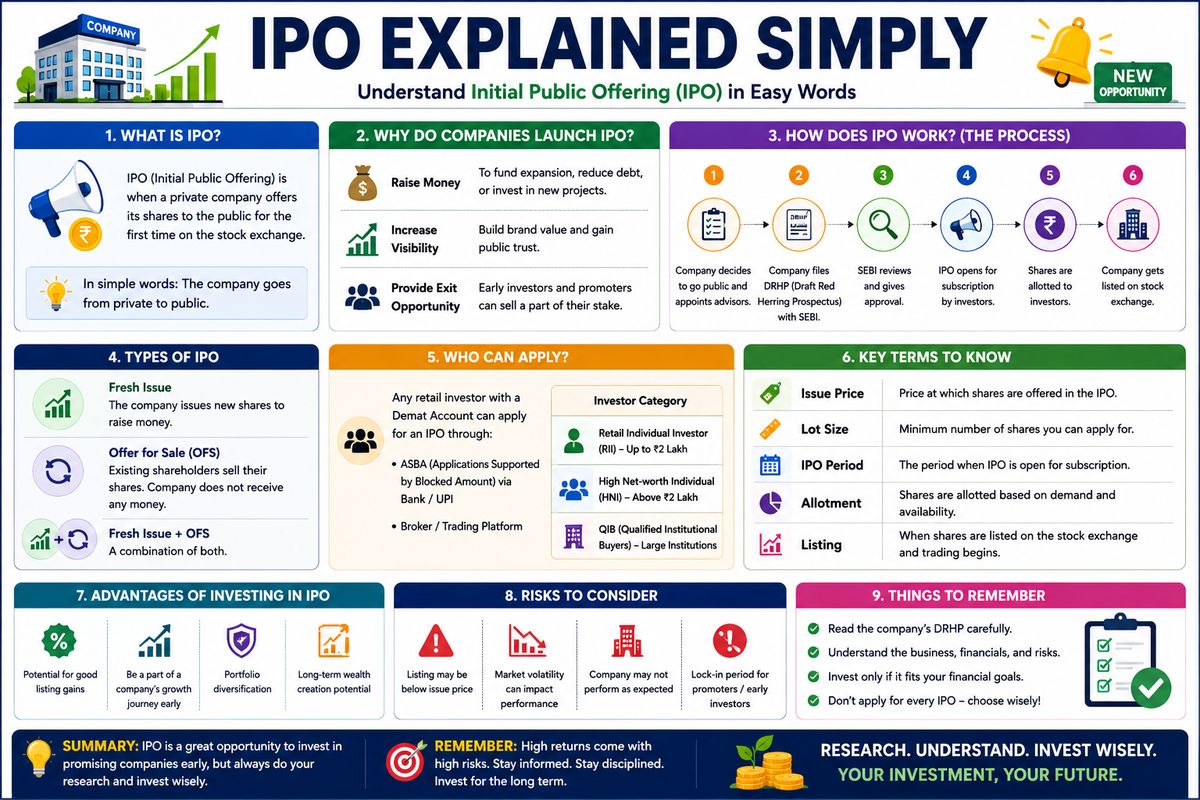
1. NSE IPO 2026: Why This IPO Matters
There are IPOs that attract attention because a new company is promising to become big. The NSE IPO is different. Investors already know the business. Millions of Indians use its ecosystem every day, brokers depend on its trading infrastructure, and its exchange sits at the centre of India's equity and derivatives market.
That is precisely why the key question is not simply “Is NSE a good company?” The more useful question is “Is NSE a good investment at the price being offered?”
The current IPO price band is ₹1,700 to ₹1,785 per share. At the upper end, the issue represents a valuation of about ₹4.42 lakh crore. The public issue is an Offer for Sale (OFS), meaning the money raised goes to selling shareholders rather than to NSE itself. The issue is scheduled to open for public subscription on September 17, 2026 and close on September 21, 2026.
Our starting point
A strong business does not remove valuation risk. NSE has an exceptional competitive position, very high profitability and a powerful market network. But at roughly ₹4.42 lakh crore of market capitalisation, investors are paying a premium for that quality. The investment decision therefore needs to balance business quality against the price paid.
2. NSE IPO 2026: Key Details at a Glance
| IPO Detail | Information |
|---|---|
| Company | National Stock Exchange of India Limited |
| IPO type | Offer for Sale (OFS) |
| Price band | ₹1,700 – ₹1,785 per share |
| Upper-end issue size | Approximately ₹22,562 crore |
| Shares offered | Up to 12.64 crore equity shares |
| Face value | ₹1 per share |
| Retail lot size | 8 shares |
| Minimum retail application at ₹1,785 | ₹14,280 |
| Public issue opens | September 17, 2026 |
| Public issue closes | September 21, 2026 |
| Anchor bidding | September 16, 2026 |
| Proposed listing exchange | BSE |
| Approx. market cap at ₹1,785 | ₹4.42 lakh crore |
The lot size means a retail investor applying at the upper price band would need at least ₹14,280 for one lot. Retail investors are eligible for at least 35% of the net offer, while qualified institutional buyers can receive up to 50%.
3. What Is Actually Being Sold in the NSE IPO?
This point is easy to miss and extremely important.
The NSE IPO is not a fresh issue of shares by the company. It is an OFS. Existing shareholders are selling part of their holdings to public investors. NSE itself does not receive the IPO proceeds.
That changes how you should think about the offering. A conventional fresh issue can provide capital to a company for expansion, debt repayment, acquisitions or working capital. Here, the investment case is primarily about owning a piece of NSE's future earnings and cash generation, rather than financing a new expansion programme with IPO money.
Why the OFS structure matters
The absence of fresh capital is not automatically negative. NSE already generates substantial cash and has a highly profitable business. But investors should not give the IPO a “growth capital” premium simply because it is a large issue. The ₹22,562 crore headline is largely liquidity for selling shareholders, not new money going into NSE's balance sheet.
4. How Does NSE Make Money?
The easiest way to understand NSE is to think of it as financial-market infrastructure. It provides the marketplace and related services through which investors, traders, brokers and institutions transact.
Its revenue comes from several activities, including transaction charges, listing services, data feeds and terminal services, connectivity and data-centre related services. Transaction charges are by far the largest component.
In FY2026, transaction charges were about ₹13,057 crore, representing roughly 78.65% of operating revenue. For the quarter ended June 30, 2026, transaction charges were about ₹3,623 crore, or nearly 79.5% of operating revenue.
This is both a strength and a risk. The strength is that NSE has a very scalable transaction-led model. The risk is that earnings are closely linked to market activity, product mix and the regulatory environment around trading.
5. NSE Financial Performance: The Numbers Investors Need to Know
NSE's financial profile is one of the strongest arguments in favour of the IPO. According to the company's IPO disclosures, revenue from operations increased from approximately ₹14,780 crore in FY2024 to ₹16,601 crore in FY2026. Profit increased from around ₹8,306 crore to ₹10,302 crore over the same period.
| Financial metric | FY2024 | FY2026 |
|---|---|---|
| Revenue from operations | ₹14,780 crore | ₹16,601 crore |
| Profit | ₹8,306 crore | ₹10,302 crore |
| Operating EBITDA margin | 66.78% | 66.85% |
| PAT margin | 47.13% | 50.98% |
| EPS | ₹33.56 | ₹41.62 |
| ROE | 37.37% | 32.98% |
The important detail here is not merely that profit increased. NSE has maintained an operating EBITDA margin of roughly two-thirds of operating revenue, while its PAT margin reached about 51% in FY2026. That kind of profitability is unusual and reflects the economics of a scaled exchange platform.
6. NSE IPO Valuation at ₹1,785: Is It Expensive?
This is the section that matters most if you are deciding whether to apply.
At ₹1,785 per share and approximately 24.75 crore paid-up shares after the offer, NSE's implied market capitalisation is about ₹4.42 lakh crore. At ₹1,700, the implied market capitalisation is about ₹4.21 lakh crore.
Using the FY2026 diluted EPS of ₹41.62 disclosed in the IPO materials, the simple price-to-earnings calculation is approximately:
P/E calculation
₹1,785 ÷ ₹41.62 ≈ 42.9× FY2026 earnings
At ₹1,700, the equivalent multiple is approximately 40.8×.
The company's disclosures indicate that the peer-industry average P/E is around 54.28×. On that comparison, NSE does not appear optically expensive relative to the cited peer set. But there is a major caveat: peer multiples are not a perfect benchmark because exchanges have different market positions, product mixes, growth rates, regulatory structures and competitive threats.
So I would not call ₹1,785 “cheap”. I would call it a premium valuation for a high-quality market-infrastructure business. The question is whether NSE can continue growing earnings strongly enough to justify that premium over several years.
7. Why NSE Has a Powerful Competitive Advantage
The biggest asset NSE has is not a factory, building or piece of equipment. It is the market ecosystem built around the exchange.
- Liquidity: Traders prefer venues where they can enter and exit positions efficiently.
- Network effects: More participants can attract more liquidity, which can attract still more participants.
- Brand and trust: NSE is one of India's most recognised financial-market institutions.
- Technology infrastructure: High-speed trading requires reliable systems, connectivity and data services.
- Product breadth: NSE operates across cash equities, derivatives, currency products and related market infrastructure.
The company's IPO disclosures state that NSE has been India's largest stock exchange by total turnover in cash equity and equity derivatives from FY2011 through FY2026, and in exchange-traded currency derivatives from FY2009 through FY2026. The disclosures also cite global leadership by number of trades in cash equities and equity derivatives in FY2026.
That market position is difficult for a new competitor to reproduce. An exchange becomes stronger as liquidity and participation concentrate around it. That is one of the most important reasons the NSE story deserves a premium valuation.
8. What Could Drive NSE's Growth After Listing?
1. India's expanding investor base
India's participation in financial markets continues to broaden. NSE's unique registered investor base rose from about 30.87 million at March 31, 2020 to 132.37 million at June 30, 2026, according to the IPO disclosures cited by Indian Express.
2. Derivatives activity
Equity derivatives are a major part of NSE's economic engine. Continued participation from retail and institutional traders can support transaction revenue, although this is also one of the company's largest regulatory risks.
3. New products and services
Data, connectivity, listings and other market-infrastructure services can diversify the revenue base over time. A larger ecosystem also gives NSE opportunities to monetise the market activity it already facilitates.
4. Financialisation of household savings
If Indian household savings continue moving from physical assets and traditional savings products toward equities, mutual funds and other market-linked instruments, exchanges and related infrastructure providers can benefit from the long-term increase in market participation.
5. Operating leverage
An exchange platform can handle additional transaction volume without costs rising in direct proportion to revenue. If volumes grow faster than the cost base, profitability can remain high or improve.
9. The Risks: This Is Where Investors Need to Be Honest
The NSE story looks attractive partly because its competitive position is so strong. But investors should not confuse market dominance with zero risk.
Regulatory risk
Financial exchanges operate in a heavily regulated environment. Changes to derivatives rules, contract specifications, expiry mechanisms, transaction structures or investor-protection measures can affect trading volumes and revenue.
This risk deserves particular attention because transaction charges account for nearly four-fifths of NSE's operating revenue.
Concentration in transaction revenue
High transaction revenue is an excellent business when volumes are strong. It also means the company is exposed to market activity and product mix. If trading volumes fall sharply, or if regulations reduce high-frequency derivatives activity, revenue growth can slow.
Valuation risk
At around 43× FY2026 earnings at ₹1,785, investors are not buying a neglected company. Expectations are already high. If earnings disappoint, even a profitable and dominant company can see its share price fall.
Market-cycle risk
Trading activity is not linear. Strong bull markets, high volatility and increased derivatives participation can support exchange earnings. Quiet markets can produce a very different environment.
Competition from BSE and future market structures
NSE has a dominant position, but investors should still monitor competition. BSE has been investing in its own market products and gaining attention in some segments. The relevant question is not whether BSE will suddenly replace NSE; it is whether NSE can maintain its current share and pricing power.
Long regulatory history before the IPO
NSE's public-market journey has taken years and has involved regulatory and legal issues. That history does not automatically make the company a bad investment, but it is a reminder that exchanges are unusual businesses with a significant regulatory interface. Reuters noted that NSE first filed to go public in 2016 and faced years of delays.
10. What About NSE IPO GMP?
The grey market premium, or GMP, can become one of the most searched NSE IPO terms before listing. But investors should be careful about giving it too much importance.
GMP is an unofficial indicator from the grey market. It is not the same thing as the official listing price, and it is not a substitute for analysing earnings, valuation and risk.
If the GMP suggests a premium, that may indicate strong short-term demand. It does not prove that the stock is attractively valued for a five-year investment. Conversely, a weak GMP does not automatically mean the company is poor.
Investor rule
Use GMP as a sentiment indicator, not as an investment thesis. The business and the valuation should determine your decision; grey-market chatter should not.
11. NSE vs BSE: Which Exchange Stock Is More Attractive?
For investors comparing the two exchange businesses, the most important difference is market position.
| Factor | NSE | BSE |
|---|---|---|
| Market position | Dominant in several major trading segments | Strong heritage and competitive presence |
| Investor interest | Very high due to IPO and scale | Already listed and publicly traded |
| Revenue model | Transaction-led with other market services | Transaction-led with diversified exchange services |
| Key advantage | Liquidity, scale and network effects | Established brand and competitive product expansion |
| Key risk | Valuation and regulatory dependence | Competitive execution and market-share dynamics |
This is not a simple “NSE good, BSE bad” comparison. NSE's IPO valuation needs to be judged on expected future earnings, while BSE's existing share price reflects a different set of expectations. Investors should compare valuation multiples, earnings growth, market share and cash generation rather than choosing only by brand recognition.
12. Should You Apply for the NSE IPO at ₹1,785?
Here is the blunt version: I would not apply simply because NSE is the National Stock Exchange.
The company has an exceptional franchise, strong profitability and a structural position in India's financial system. Those are real advantages. At the same time, the IPO valuation already recognises a lot of that quality.
For an investor with a long-term horizon, the IPO becomes more interesting because the thesis is based on India's growing financial-market participation, NSE's dominant ecosystem and its ability to generate high-margin earnings.
For a purely listing-gain-focused investor, the decision is different. Short-term returns will depend on subscription demand, market conditions, institutional participation and the valuation investors are willing to pay on listing day. None of those are guaranteed.
| Investor type | How I would view NSE IPO |
|---|---|
| Long-term investor | Worth serious consideration, but valuation discipline is essential. |
| Dividend/income investor | Interesting, but evaluate future payout policy rather than assuming past dividends will continue at the same rate. |
| IPO listing-gain trader | Higher uncertainty. Do not treat GMP or hype as guaranteed profit. |
| Very valuation-sensitive investor | ₹1,785 is not an obvious bargain; waiting for a more attractive entry may make sense. |
13. NSE Share Price: Bull, Base and Bear Scenarios
Instead of pretending that anyone can predict the exact NSE listing price, it is more useful to think in scenarios.
| Scenario | What needs to happen | Potential outcome |
|---|---|---|
| Bull case | Strong market participation, continued derivatives growth, healthy earnings growth and stable regulation. | Premium valuation expands or remains supported. |
| Base case | Steady investor growth, normalising trading volumes and moderate earnings growth. | Share price broadly follows earnings over time. |
| Bear case | Regulatory pressure on derivatives, weaker volumes, slower earnings growth or broad market correction. | P/E multiple contracts and the stock can fall despite NSE remaining profitable. |
The key lesson is simple: the share price can decline even when the business remains excellent. If earnings grow at 8% but the market decides the correct P/E should fall materially, shareholders can still lose money.
14. What Investors Should Monitor After Listing
If you receive NSE shares, do not stop analysing the company after the IPO. The real investment period begins after listing.
- Transaction revenue growth: Watch whether transaction charges continue to grow faster than the overall cost base.
- Equity derivatives volumes: Track changes in volumes and the product mix.
- Cash-market market share: A dominant position is valuable only if it remains strong.
- New investor registrations: Continued expansion can support long-term market activity.
- Operating margins: NSE's high-margin model is one of its biggest attractions.
- Regulatory changes: New SEBI rules can have a direct impact on the business model.
- Valuation: Recalculate the P/E as earnings change. Do not anchor forever to the IPO price.
- Capital allocation and dividends: Watch how management uses the company's substantial cash generation.
15. A Simple Framework Before You Apply
Before placing an IPO application, answer these five questions honestly:
- Would I buy NSE if it were already listed? If the answer is no, IPO hype should not change your decision.
- Am I buying for three days or five years? The appropriate analysis is completely different.
- Can I tolerate a 20–30% fall after listing? A strong company can still have a weak entry point.
- Does the valuation make sense against earnings growth? Compare the multiple with realistic future growth, not only with peer averages.
- What would make my thesis wrong? If you cannot identify the risks, you do not yet have an investment thesis.
Our view
At ₹1,785, NSE looks more like a high-quality business at a premium price than a classic bargain IPO. That does not make it unattractive. It means the investor should have a long-term thesis and avoid assuming that a famous company automatically guarantees listing gains.
16. Final Verdict: Is NSE IPO at ₹1,785 Worth Buying?
NSE is one of the rare IPO candidates where the business quality is not the biggest question. Its competitive position, scale, profitability and role in India's capital markets are already well established.
The harder question is price.
At ₹1,785, NSE is being valued at roughly ₹4.42 lakh crore and around 42.9 times FY2026 diluted earnings based on the disclosed ₹41.62 EPS. That is a premium valuation, but it is not obviously irrational when compared with the cited industry peer multiple and NSE's unusually strong profitability.
For a long-term investor who believes India's financialisation will continue and NSE can maintain its market leadership, the IPO deserves serious consideration. For someone chasing a quick listing pop, the risk-reward is much less certain.
Our bottom line: NSE is a business worth owning; whether ₹1,785 is the right price depends on your investment horizon, valuation discipline and tolerance for post-listing volatility. Do not confuse a strong franchise with a guaranteed short-term return.
Important: IPO dates, price, lot size, allocation and other offer terms can change before listing. Always verify the latest RHP/official NSE disclosures before submitting an application.
17. Primary Sources & Further Reading
- NSE Investor Relations — IPO Offer Documents
- NSE — Annual Reports
- SEBI — Public Issue Filings
- NSE — Shareholding Information
Market news and independent reporting were also reviewed for the latest IPO terms and market context. Readers should treat the official RHP and NSE disclosures as the primary source for final offer terms.
18. Frequently Asked Questions About NSE IPO 2026
What is the NSE IPO price band?
The NSE IPO price band is ₹1,700 to ₹1,785 per share.
When will the NSE IPO open?
The public issue is scheduled to open on September 17, 2026 and close on September 21, 2026. Anchor bidding is scheduled for September 16.
What is the NSE IPO lot size?
The retail lot size is 8 shares. At the upper price band of ₹1,785, one lot requires ₹14,280.
Is the NSE IPO a fresh issue?
No. The issue is an Offer for Sale. Existing shareholders are selling shares, and NSE itself does not receive the IPO proceeds.
What is NSE's valuation at ₹1,785?
At ₹1,785 per share, the implied market capitalisation is approximately ₹4.42 lakh crore.
What is NSE's P/E ratio at ₹1,785?
Using FY2026 diluted EPS of ₹41.62, ₹1,785 implies a P/E of approximately 42.9 times.
Is NSE IPO good for long-term investment?
NSE has strong competitive advantages and high profitability, so it deserves serious long-term consideration. However, the IPO price is not a bargain, and investors should consider valuation, regulatory risk and dependence on transaction activity before investing.
Should I apply for NSE IPO for listing gains?
There is no guaranteed listing gain. GMP, subscription demand and market conditions can change quickly. A listing-gain strategy is substantially more speculative than a long-term investment thesis.
Where will NSE shares be listed?
The proposed listing is on BSE, which is the designated stock exchange for the offer.