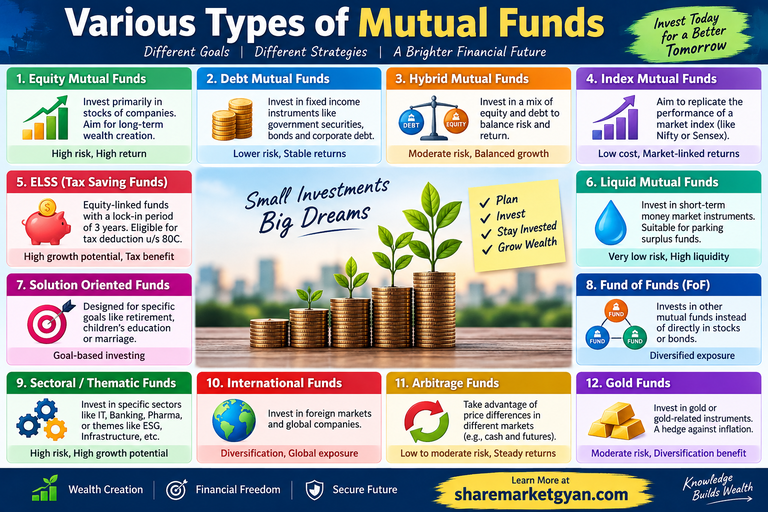
1. Introduction
If you have ever looked at a mutual fund list and wondered why there are so many different names, you are not alone. Mutual funds are not one single type of investment. They are available in several categories, and the biggest difference between them is where the fund invests your money.
One mutual fund may invest mainly in company shares, another may focus on bonds and other fixed-income securities, while another may combine shares and debt. There are also funds that follow an index, invest in a particular sector, or invest in overseas markets.
Understanding these categories is important because the name of a fund does not tell you everything. Two mutual funds can both offer SIPs, but their risks and expected behaviour can be completely different.
The simple idea
Before choosing a mutual fund, first understand what the fund invests in, why you are investing, how long you can stay invested, and how much temporary loss you can comfortably handle.
2. What Is a Mutual Fund?
A mutual fund collects money from many investors and uses that pooled money to invest in securities according to the fund's stated objective. The investments are managed by a professional fund management team.
For example, instead of buying shares of 20 companies yourself, you can invest in an equity mutual fund that already holds a portfolio of companies. You own units of the mutual fund, and the value of those units changes according to the value of the underlying investments, after expenses and other applicable adjustments.
This structure makes diversification easier for many investors. However, diversification does not mean there is no risk. The type of securities held by the fund largely determines how the investment may behave.
3. Equity Mutual Funds
Equity mutual funds invest primarily in shares of companies. Because share prices can move significantly over short periods, equity funds generally carry higher market risk than debt-oriented funds. They are usually more suitable for investors who have a longer investment horizon and can tolerate market fluctuations.
Common equity fund categories
- Large-cap funds: Primarily invest in large, established companies.
- Mid-cap funds: Focus mainly on mid-sized companies, which can have greater growth potential as well as greater volatility.
- Small-cap funds: Invest mainly in smaller companies and can experience substantial price swings.
- Large & mid-cap funds: Combine investments in large-cap and mid-cap companies according to the category rules.
- Multi-cap funds: Invest across large-, mid- and small-cap companies.
- Flexi-cap funds: Give the fund manager flexibility to invest across market capitalisation segments.
- Value and contra funds: Follow strategies based on value-oriented or contrarian investment approaches.
These categories can behave differently even though they all invest in equities. A small-cap fund, for instance, can be much more volatile than a large-cap fund during a weak market.
4. Debt Mutual Funds
Debt funds invest mainly in fixed-income securities such as government securities, treasury bills, corporate bonds, commercial paper and other money-market instruments. They are generally used by investors looking for relatively more stable returns than equity funds, although debt funds are not risk-free.
Debt funds can be affected by interest-rate movements, changes in bond prices, credit quality and liquidity. The risk can vary considerably between categories.
Examples of debt fund categories
- Liquid funds: Invest in short-term money-market and debt instruments and are commonly used for short-term parking of money.
- Ultra-short and low-duration funds: Generally hold relatively short-duration portfolios.
- Short-duration and medium-duration funds: Take somewhat longer maturity exposure and can therefore have greater interest-rate sensitivity.
- Corporate bond funds: Focus primarily on higher-rated corporate debt.
- Gilt funds: Invest mainly in government securities. They have low credit risk but can still experience price movements when interest rates change.
- Credit-risk funds: Take greater exposure to lower-rated corporate debt and therefore carry higher credit risk.
Debt does not mean guaranteed
A common mistake is to assume that a debt mutual fund works like a fixed deposit. It does not. The value of a debt fund can fall, particularly when bond prices are affected by interest-rate changes or when credit concerns arise.
5. Hybrid Mutual Funds
Hybrid funds invest in a combination of asset classes, mainly equity and debt. The idea is to create a portfolio that does not depend entirely on one type of investment.
The balance between equity and debt differs from one hybrid category to another. That difference matters because a fund with a larger equity allocation can behave very differently from one with a larger debt allocation.
| Category | Basic idea | What to understand |
|---|---|---|
| Conservative Hybrid | Higher allocation to debt with some equity | Lower equity exposure, but still not risk-free |
| Balanced / Aggressive Hybrid | Combines equity and debt in defined proportions | Risk depends on the equity allocation and portfolio |
| Dynamic Asset Allocation | May change equity/debt allocation based on the fund's strategy | Understand the model used to alter allocation |
| Multi-Asset Allocation | Invests across at least three asset classes subject to category rules | Provides exposure beyond just equity and debt |
| Arbitrage | Uses price differences between market segments | Returns depend on available arbitrage opportunities and market conditions |
6. Index Funds
An index fund aims to track a particular market index rather than trying to regularly select stocks that will outperform the index. For example, a fund may track an index representing large Indian companies.
The objective is generally to keep the portfolio aligned with the index, so the fund's performance should broadly follow the index after expenses and tracking differences.
Index funds are often considered a simple way to get diversified market exposure. They also tend to have a relatively straightforward investment approach. But the fact that a fund is an index fund does not remove market risk: if the underlying index falls, the fund will generally fall as well.
7. ELSS Mutual Funds
Equity Linked Savings Scheme (ELSS) is an equity-oriented mutual fund category associated with tax-saving investments under the applicable provisions of Indian income-tax law.
ELSS funds invest in equities and come with a three-year lock-in period for each investment. This makes them different from ordinary equity mutual funds where there is generally no such statutory lock-in.
Investors should not choose ELSS only because it is associated with tax benefits. It remains an equity investment, so the value can rise and fall with the market. Tax rules can also change, so investors should check the rules applicable to their situation before making a decision.
8. Sectoral and Thematic Funds
Sectoral funds concentrate on a particular industry or sector, such as banking, pharmaceuticals or information technology. Thematic funds are usually broader and invest around a particular theme, such as infrastructure, manufacturing or consumption.
The attraction is obvious: if the chosen sector or theme performs strongly, the fund can benefit significantly. The problem is concentration. If the sector or theme struggles, the fund can also underperform the broader market by a wide margin.
These funds therefore require more understanding of the underlying industry and are generally less diversified than broad-market equity funds.
9. Solution-Oriented Funds
Solution-oriented funds are designed around specific long-term objectives rather than simply following a broad asset category. Common examples include funds designed around retirement planning or children's future education.
The important point is that the objective is built into the product's structure. Some solution-oriented schemes can also have a lock-in period or restrictions, so investors should read the scheme documents carefully rather than assuming that all mutual funds can be redeemed whenever they want.
10. Fund of Funds
A Fund of Funds (FoF) invests primarily in other mutual funds or specified funds instead of directly building the entire portfolio from individual securities.
This structure can be useful when the investment strategy requires exposure to another fund or group of funds. However, investors should understand the cost structure because there can be expenses at more than one level, depending on the structure.
11. International and Overseas Funds
International funds invest in securities outside India, either directly or through overseas funds, depending on the scheme. They can provide exposure to companies, markets and sectors that are not easily available through Indian-only funds.
However, overseas investing adds another layer of risk. Currency movements can affect returns, and the foreign market itself can behave differently from the Indian market. Regulations, taxation and investment limits can also change.
For this reason, international funds are better viewed as a way to diversify geographically rather than as a guaranteed method of earning higher returns.
12. Other Ways Mutual Funds Can Be Classified
Mutual funds can also be understood from other angles. These classifications are useful because the same fund can be described in several ways.
- Open-ended funds: Generally allow investors to buy and redeem units on an ongoing basis, subject to the scheme's terms.
- Close-ended funds: Have a defined maturity period, with units typically issued during a specified period and listed where applicable.
- Active funds: The fund manager makes investment decisions with the aim of meeting the scheme's objective, often including an attempt to outperform a benchmark.
- Passive funds: Aim to track an index or predefined strategy rather than actively selecting investments to outperform a benchmark.
- Growth-oriented schemes: Focus on capital appreciation and may reinvest income rather than paying it out regularly.
13. Comparing the Major Mutual Fund Types
| Type | Main Investment | Typical Risk Level | Usually Considered For |
|---|---|---|---|
| Equity | Company shares | High | Long-term wealth creation |
| Debt | Bonds and money-market instruments | Low to moderate, depending on category | Income/stability-oriented goals |
| Hybrid | Combination of asset classes | Low to high, depending on mix | Investors seeking a mixed portfolio |
| Index | Market index constituents | Market-linked | Simple, diversified market exposure |
| ELSS | Equities | High | Tax-saving plus long-term equity exposure |
| Sectoral/Thematic | Specific sector or theme | High | Investors comfortable with concentration |
| International | Overseas securities/funds | Market and currency dependent | Geographical diversification |
These risk descriptions are broad guidelines, not guarantees. The actual risk depends on the portfolio, market conditions, interest rates, credit quality, concentration and the fund's investment strategy.
14. How Should You Choose a Mutual Fund Category?
The better question is not “Which mutual fund gives the highest return?” A more useful question is “Which category matches my goal and my ability to handle risk?”
Start with the goal
Decide what the money is for: long-term wealth creation, a future expense, tax planning, short-term parking or another specific purpose.
Look at the time horizon
Equity-heavy categories generally need more time because markets can go through long periods of volatility. A short-term goal should not automatically be placed in a high-risk equity category.
Understand the risk
Read the scheme's riskometer, portfolio and investment strategy. Do not assume a familiar fund name means low risk.
Compare the actual fund
Once you have selected a suitable category, compare costs, portfolio quality, consistency, benchmark performance and how the fund is managed.
15. What About SIP?
SIP, or Systematic Investment Plan, is not a separate type of mutual fund. It is a method of investing a fixed amount at regular intervals, commonly monthly, into a mutual fund scheme.
For example, if you invest ₹5,000 every month through an SIP, the number of units you receive will vary because the fund's unit price changes. When the price is lower, the same amount buys more units; when the price is higher, it buys fewer.
SIP can help investors build a regular investing habit, but it does not guarantee profit or protect against losses. The underlying mutual fund category still determines the investment risk.
16. Common Mistakes to Avoid
| Mistake | Why It Can Be a Problem | Better Approach |
|---|---|---|
| Choosing only by past return | A strong past period does not guarantee the same future result. | Understand category, strategy, risk and consistency. |
| Confusing SIP with a fund type | SIP is only an investment method. | First choose a suitable fund category. |
| Assuming debt funds are risk-free | Debt funds can face interest-rate and credit risks. | Check duration, credit quality and category. |
| Ignoring concentration | Sectoral and thematic funds can be highly concentrated. | Understand what the portfolio is exposed to. |
| Investing without a goal | The wrong category can create unnecessary risk. | Match the investment with the time horizon and objective. |
17. What About Taxation?
Tax treatment of mutual fund investments depends on factors such as the type of fund, the nature of the gain, the holding period and the tax rules applicable during the relevant financial year. Different categories can be treated differently.
Tax rules can also change through government legislation and budget announcements. Therefore, do not rely on an old article or a general tax assumption when making a large investment decision. Check the current rules and, where necessary, consult a qualified tax professional.
18. Key Takeaways
- Mutual funds are available in different categories based mainly on what they invest in and the objective they follow.
- Equity funds invest mainly in shares and can experience significant market volatility.
- Debt funds invest mainly in fixed-income securities but are not risk-free.
- Hybrid funds combine asset classes and can offer different levels of equity and debt exposure.
- Index funds aim to track a market index rather than actively selecting investments to beat it.
- ELSS is an equity-oriented tax-saving mutual fund category with a three-year lock-in.
- Sectoral and thematic funds can offer focused exposure but carry concentration risk.
- International funds can diversify geographically but add currency and overseas-market risks.
- SIP is an investment method, not a separate mutual fund category.
- The right category depends on your goal, time horizon and ability to handle risk—not simply the highest historical return.
19. Frequently Asked Questions
How many types of mutual funds are there?
There is no single useful number because mutual funds can be classified in different ways. The major categories include equity, debt, hybrid, index, ELSS, sectoral, thematic, solution-oriented, fund of funds and international funds, with several sub-categories within them.
Which type of mutual fund is safest?
There is no completely risk-free mutual fund. Some debt-oriented categories may have lower market volatility than equity funds, but they can still face interest-rate, credit and liquidity risks.
Is an index fund better than an actively managed fund?
Neither is automatically better for every investor. Index funds follow a passive approach, while active funds rely more on the fund manager's decisions. Costs, consistency, benchmark, risk and your preference should all be considered.
Is SIP a type of mutual fund?
No. SIP is a way of investing regularly in a mutual fund. You can use an SIP to invest in different eligible mutual fund categories.
Are equity mutual funds risky?
Yes. Equity funds are exposed to stock-market movements and can fall substantially during weak markets. Their suitability depends heavily on the investor's time horizon and ability to tolerate volatility.
Can I invest in more than one type of mutual fund?
Yes. An investor can use different mutual fund categories for different goals, provided the overall portfolio matches the investor's financial objectives, time horizon and risk tolerance.